
Which activity in your project, if delayed by a single day, delays the whole project? The answer is the Critical Path. In this guide we solve a complete example step by step: we draw the network, run the forward and backward passes, compute total float and free float, and finish with a common exam question.
We prepared this guide and its video lecture based on the questions you asked in the comments of our earlier critical path lecture. The video is narrated in Arabic, but every step and number is shown on screen.
Why does the critical path matter?
A project manager cannot watch every activity with the same attention. The critical path identifies the activities that cannot tolerate any delay, so that is where attention and resources should go. The other activities have some room to slip, called float, and we will compute exactly how much.
The problem
| Activity | Predecessor | Duration (days) |
|---|---|---|
| A | — | 3 |
| B | A | 4 |
| C | A | 2 |
| D | B | 5 |
| E | C | 1 |
| F | C | 2 |
| G | D, E | 4 |
| H | F, G | 3 |
Step 1: Draw the network
Each activity is a box, and an arrow means the next activity cannot start until the previous one finishes. Note that G has two incoming arrows (from D and E), and H has two (from F and G). These are merge points.

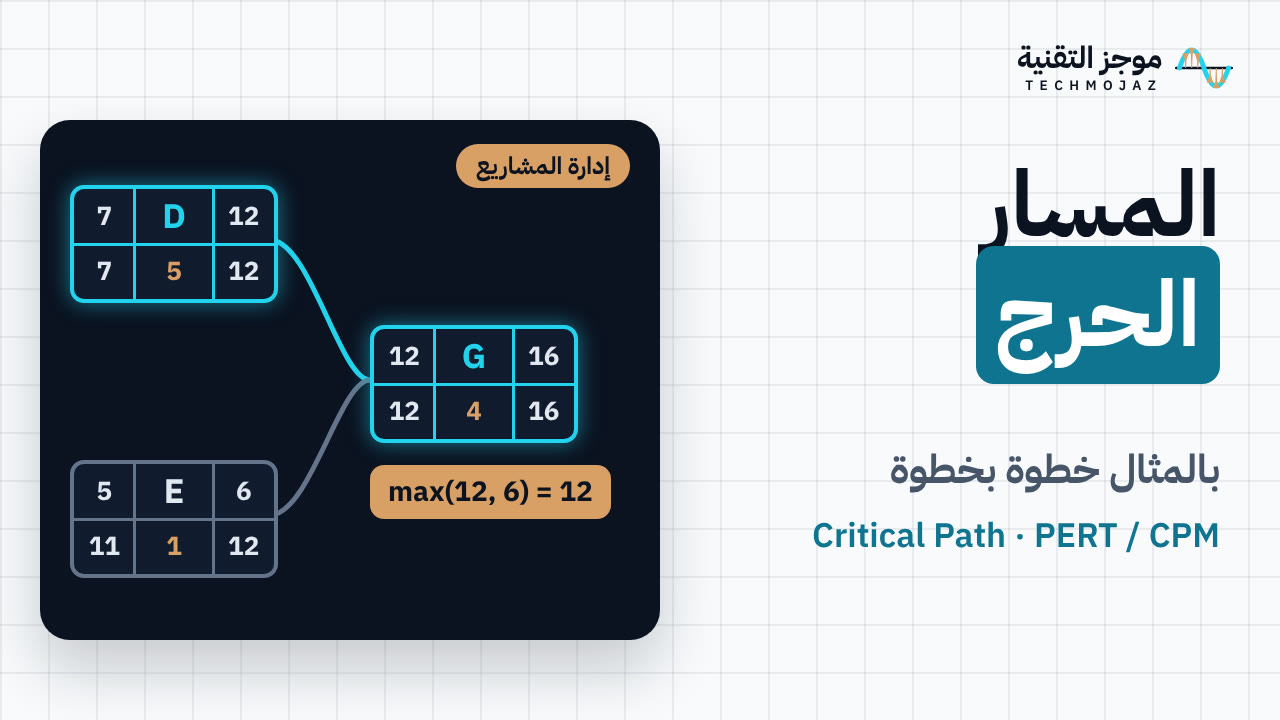
Then split each box into six cells: on top, Early Start (ES), the activity name, and Early Finish (EF); at the bottom, Late Start (LS), the duration, and Late Finish (LF).
Step 2: Forward pass (ES and EF)
- The first activity starts at time zero: ES(A) = 0.
- Early finish = early start + duration: EF = ES + t.
- The early start of an activity equals the early finish of the activity before it.
- At a merge point, take the largest: ES(G) = max(12, 6) = 12, and ES(H) = max(7, 16) = 16.

At the end of the forward pass, EF(H) = 19, so the project takes 19 days.
Step 3: Backward pass (LF and LS)
- Start at the end: LF of the last activity = its EF = 19, because we do not want to delay the project.
- Late start = late finish − duration: LS = LF − t.
- The late finish of an activity equals the late start of the activity after it.
- At a burst point, take the smallest: LF(C) = min(11, 14) = 11, and LF(A) = min(3, 9) = 3.
Two notes: if the network ends with more than one activity, the project is not complete until all of them finish, so take the largest EF among them. And if the question gives a deadline, use it as the late finish of the last activity.
Result: the critical path
Activities whose early start equals their late start are critical. So the critical path is A → B → D → G → H, and its durations add up to 3 + 4 + 5 + 4 + 3 = 19 days, the project duration itself.

Total float and free float
Total float = LS − ES: how many days an activity can slip without delaying the project.
Free float = smallest ES of the following activities − EF of the activity: how many days it can slip without delaying any activity after it.
| Activity | t | ES | EF | LS | LF | TF | FF |
|---|---|---|---|---|---|---|---|
| A | 3 | 0 | 3 | 0 | 3 | 0 | 0 |
| B | 4 | 3 | 7 | 3 | 7 | 0 | 0 |
| C | 2 | 3 | 5 | 9 | 11 | 6 | 0 |
| D | 5 | 7 | 12 | 7 | 12 | 0 | 0 |
| E | 1 | 5 | 6 | 11 | 12 | 6 | 6 |
| F | 2 | 5 | 7 | 14 | 16 | 9 | 9 |
| G | 4 | 12 | 16 | 12 | 16 | 0 | 0 |
| H | 3 | 16 | 19 | 16 | 19 | 0 | 0 |

Watch out here: activity C has a total float of 6 days, so it can slip 6 days without delaying the project. But its free float is zero: FF = 5 − 5 = 0, so every day of delay in C pushes E and F. Activity E, on the other hand, has a free float of 6 days and can slip up to 6 days without affecting anything.
Exam question: an unknown duration x
If the duration of C is unknown (x), when does C become critical? The longest path through C is A → C → E → G → H, with length 3 + x + 1 + 4 + 3 = x + 11. C becomes critical when x + 11 ≥ 19, that is when x ≥ 8. If x exceeds 8, the whole project gets longer.
Summary
- Draw the network.
- Compute forward (largest at merges) and backward (smallest at bursts).
- Find the activities with zero float: they form the critical path.
TechMojaz Team

اترك تعليقاً